Welcome to the 8th SNAG meeting!
28th - 29th of May 2026
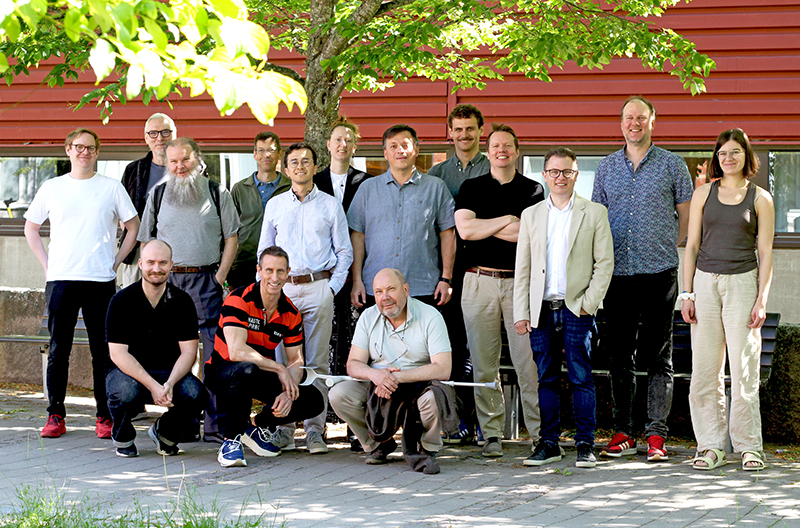
Participants of the SNAG Workshop
We are happy to announce the 8th meeting of the Swedish Network for
Algebra and Geometry. The purpose of the network is to develop the
interaction between mathematicians working in the fields of algebra
and geometry at Swedish universities. In particular, we envisage an
active participation of PhD students and young researchers with the
aim to build networks and encourage collaboration.
Organizers
Joakim Arnlind (Linköping University)
Sergei Silvestrov (Mälardalen University)
Johan Öinert (Blekinge Institute of Technology)
Venue
The meeting will take place
at Linköping University from
Thursday 28th of May to Friday 29th of May 2026. Participants
are encouraged to arrive on Wednesday 27th of May since the talks
start on Thursday morning. Please note that participants are
expected to make their own arrangements for travel and
accommodation.
Clarion
Hotel Slottsparken
and Best Western And
Hotel are two hotels that are located in the city center with a
convenient and quick bus connection to the university.
The workshop will be held in lecture hall Planck on Thursday 28th of May and in lecture hall BL32/Nobel on the 29th of May. Use MazeMap to find the location of the lecture halls on Campus.
Local transportation
To go to the university, take bus 12 from
Länsstyrelsen (closest stop to the hotels
above) to Universitetet or bus 4 from Trädgårdstorget to Nobeltorget. Timetables can be found at Östgötatrafiken.
Registration
If you would like to participate, please send an
email to Joakim
Arnlind.
Program
(Click on the title below to see the abstract.)
Thursday 28 May
09:20 - 09:30
Workshop opening
09:30 - 10:00
Self-similar modules and their combinatorics
(Jonathan Nilsson)
A module is called non-co-Hopfian if it admits a proper
embedding into itself. In this talk I will discuss combinatorial
structures and invariants associated with such modules, with
particular focus on representations of generalized Weyl
algebras.
10:10 - 10:40
Involutions in the Cayley-Dickson construction
(Sophie Pautrel)
A *-algebra is an algebra equipped with an involution. The
Cayley–Dickson construction builds new *-algebras from a given
one, generalizing the construction of the complex numbers from
the real numbers. Classically, this uses an involution
corresponding to complex conjugation - but is that the only
choice?
(pdf)
10:40 - 11:10
Coffee break
11:10 - 11:40
*-algebra structures on path algebras
(Victor Hildebrandsson)
With motivation from noncommutative geometry, we want to know
when there exists a *-algebra structure on path algebras of
quivers. We consider quivers with anti-involutions and show that
a path algebra admits a *-algebra structure if and only if there
exists an anti-involution on its underlying quiver. We finish
the talk with a discussion of future investigations.
(pdf)
11:50 - 12:20
Rigidity and Flexibility of Hypergraphs through Graphs of Groups
(Joannes Vermant)
Rigidity theory studies when a geometric realisation of a graph
or hypergraph is determined, up to rigid motions, by prescribed
constraints such as distances or preserved normals. Classical
examples include bar-joint frameworks in the Euclidean plane,
where generic rigidity admits a purely combinatorial
characterisation. In this talk, I will present a
group-theoretic framework for rigidity developed in joint work
with Klara Stokes. Using graphs of groups, we describe motions
and infinitesimal motions in a unified setting encompassing a
range of rigidity problems, including symmetric and
surface-based frameworks. The resulting structure naturally
forms a groupoid encoding compatible local deformations. I will
discuss how this perspective leads to rigidity criteria
generalising the classical theory in the plane, and how it
relates to recent sheaf-theoretic approaches to infinitesimal
rigidity on graphs.
(pdf)
12:20 - 13:30
Lunch at Universitetsklubben
13:30 - 14:00
Fast Matrix Multiplication, the 3-tensor Rank Problem, and Moduli Spaces
(Lars Hellström)
Strassen's famous discovery of an $O(n^{2.81})$
algorithm for general matrix multiplication became a milestone
in the theory of arithmetic complexity and sparked much
research. It turns out the central object is the multiplication
3-tensor, known as the structure constants of an algebra, and
the arithmetic complexity is determined by the rank of this
tensor. In principle the rank is algorithmically decidable, but
since the trivial algorithm is an application of the Buchberger
algorithm, in practice it is not. A confounding factor is that
the objects considered exhibit a rather large symmetry group,
which you normally would expect to make things easier, but when
Gröbner bases are involved rather makes everything more
difficult. Finding techniques to take advantage of symmetries is
an important open problem, that perhaps SNAG could approach from
new directions. I will explain the problem basics and report on
some (old) work by Daniel Andrén, Klas Markström,
and myself on the matter.
(pdf)
14:10 - 14:40
Hilbert’s Basis Theorem for Wildebeests
(Per Bäck)
I will show a generalization of Hilbert’s basis theorem to a
class of noncommutative nonassociative polynomial rings known as
generalized Ore extensions (GNOEs), or wildebeests. This is
joint work with Masood Aryapoor.
(pdf)
14:40 - 15:10
Coffee break
15:10 - 15:40
Factor systems for strongly graded rings
(Joakim Arnlind)
Graded rings provide a natural algebraic framework for encoding
symmetry via decompositions into homogeneous components indexed
by a group. Among graded rings, strongly graded rings form a
particularly well-behaved and structurally rich class. In this
talk I will introduce a notion of factor systems for strongly
graded rings, consisting of algebraic data that encode both the
bimodule structure of the homogeneous components and their
algebraic relations. We show that strongly graded rings with
fixed principal component are classified, up to isomorphism, by
conjugacy classes of such factor systems. Conversely, every
abstract factor system gives rise to a strongly graded ring
realizing it. Furthermore, factor systems also provide a
convenient framework for studying the problem of lifting
derivations from the principal component to graded derivations
of the whole ring. We derive explicit compatibility conditions
for the existence of such lifts and interpret the resulting
obstructions in cohomological terms. This is joint work with
Stefan Wagner.
(pdf)
18:00 - 21:00
Dinner at Horse and Hound (map)
Friday 29 May
09:30 - 10:00
Central idempotents in group-graded rings
(Johan Öinert)
Let G be a group and let R be a G-graded ring. We show that a nonzero
central idempotent in R has finite support group in two broad settings:
when G is abelian, and when G is arbitrary but the grading satisfies a
certain one-sided non-annihilation condition on nonzero homogeneous
elements. In particular, in both settings, when G is torsion-free, every
central idempotent lies in the principal component of the grading. Our
results generalize those of H. Bass and R. G. Burns from group rings to
noncommutative, possibly non-unital, group-graded rings. We demonstrate
the utility of our results by applying them to various classes of rings.
(pdf)
10:10 - 10:40
S-palintropic algebras
(Vladimir G. Tkachev)
At SNAG 2024, I announced a class of so‑called strange
algebras defined by the simple identity
$S(x)=(x^3)^2−(x^2)^3=0$. The principal motivation for this
class is the triviality of its Peirce polynomial, which implies
that there are no a priori restrictions on the spectrum of the
algebra. It is known that a fairly broad range of familiar
algebras - including Jordan and medial algebras - satisfy this
identity. Moreover, a related class of algebras, the palintropic
algebras, was introduced earlier by Etherington. In this talk,
I will present recent developments in the theory. In particular,
an unexpected phenomenon has emerged: despite the vanishing of
the Peirce polynomial, the fusion rules governing multiplication
between Peirce subspaces can be described explicitly. A second
surprising property is that, in such algebras, multiplication by
an idempotent defines an algebra homomorphism. Finally, several
explicit examples of S-palintropic algebras will be discussed.
(pdf)
10:40 - 11:10
Coffee break and group photo
11:10 - 11:40
Separable functors and firm modules
(Patrik Lundström)
We develop a theory of separable ring extensions and separable
functors for nonunital rings in the setting of firm modules. We
prove nonunital analogues of classical results on functorial
separability and semisimplicity, and apply these results to
obtain a locally unital version of Maschke's theorem for group
rings.
(pdf)
11:50 - 12:20
Constructing Koszul filtrations
(Lisa Nicklasson)
A standard graded commutative algebra A is called Koszul if its
residue field has a linear free resolution over A. These
resolutions are in general infinite, which makes proving
Koszulness a challenging task. However, there are several tools
one may use. The most common method is to prove that the algebra
is G-quadratic, meaning that its defining ideal has a quadratic
Gröbner basis, possibly after a change of coordinates. An
alternative method is to find a Koszul filtration.
Both being G-quadratic and having a Koszul filtration are
sufficient, but not necessary, conditions for being Koszul. In
our recent work, we study the relationship between these two
properties. It is known that there are algebras with Koszul
filtrations that are not G-quadratic. But does every G-quadratic
algebra have a Koszul filtration?
(pdf)
12:20 - 13:30
Lunch at Universitetsklubben
13:30 - 14:00
On (n-)representation-finite self-injective and hereditary algebras
(Erik Darpö)
In the early eighties, Riedtmann showed that there is a close
connection between the module category of a
representation-finite self-injective algebra B, and that of a
certain hereditary algebra A associated with B. This connection
is given in terms of Auslander-Reiten (AR) quivers: The AR
quiver of B can be obtained by gluing together several copies of
the AR quiver of A, and taking orbits under a certain group
action. A modern interpretation of her result is given by the
existence of a full and dense functor from the bounded derived
category of A to the stable module category of B.
In this talk, I shall give an overview of Riedtmann's
construction, and discuss some of the problems and possibilities
that arise when trying to generalise her result from the point
of view of higher-dimensional Auslander-Reiten theory.
(pdf)
14:40 - 15:10
Workshop closing and farewell coffee break
Participants
| Mats Aigner | (Linköping University) |
| Joakim Arnlind | (Linköping University) |
| Per Bäck | (Mälardalen University) |
| Erik Darpö | (Linköping University) |
| Lars Hellström | (Mälardalen University) |
| Victor Hildebrandsson | (Linköping University) |
| Patrik Lundström | (University West) |
| Lisa Nicklasson | (Mälardalen University) |
| Jonathan Nilsson | (Linköping University) |
| Sophie Pautrel | (Mälardalen University) |
| Johan Richter | (Blekinge Institute of Technology) |
| Sergei Silvestrov | (Mälardalen University) |
| Vladimir G. Tkachev | (Linköping University) |
| Joannes Vermant | (Umeå University) |
| Johan Öinert | (Blekinge Institute of Technology / The University of Skövde) |